
Looking for a “Roomba pool cleaner”?
If you mean a machine that cleans the pool automatically, the product category is a robotic pool cleaner. Roomba is iRobot’s household floor-cleaning line; do not put a household robot vacuum in a swimming pool. Pool robots are purpose-built for underwater use, with their own coverage limits and maintenance requirements.
There is a historical connection: iRobot introduced the Mirra 530 pool-cleaning robot in 2013. That older product is distinct from a Roomba. If you find a used Mirra or another older cleaner, confirm its model, manual, parts availability, and condition before buying.
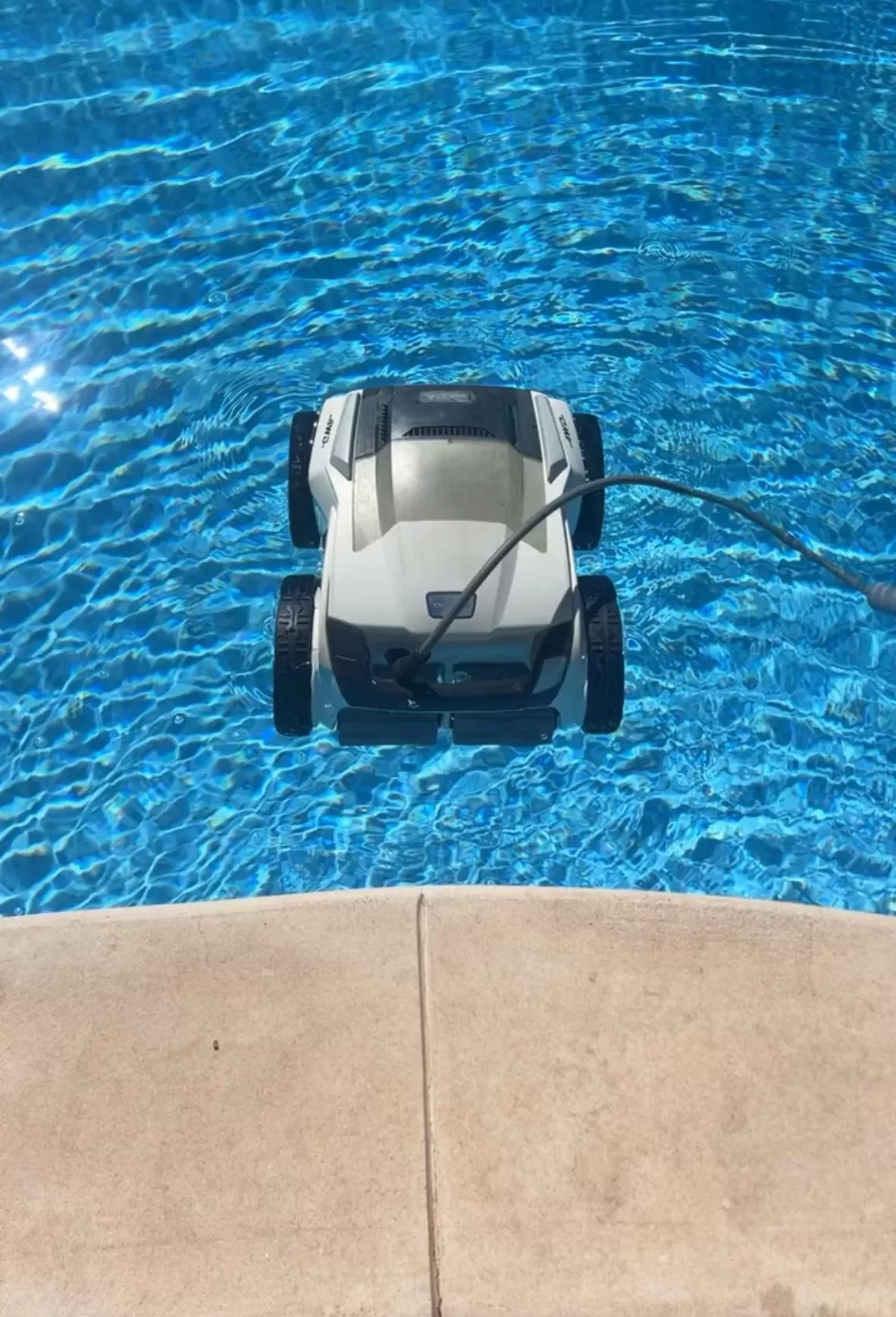
What a pool robot actually does
A robotic pool cleaner moves over the surfaces it is designed to reach and collects debris in a removable filter. Some models clean only the floor; others add wall and waterline cleaning. A surface-skimming robot has a different job. None of those descriptions automatically includes stairs, benches, or every shallow tanning ledge.
Think about where you spend the most time cleaning. If dust collects on the floor, filtration and coverage matter. If leaves accumulate on top, surface skimming still matters. If a shelf needs regular brushing, ask specifically whether the model can reach that shelf rather than assuming a wall-climbing claim covers it.
Corded or cordless?
- Corded: Check the usable reach from the approved power-supply location, cable handling, and electrical requirements. Not every model includes a swivel, timer, or app.
- Cordless: Check runtime for the chosen mode, charging instructions, battery service options, and how to retrieve the unit when its cycle ends.
- Either type: Compare lifting effort, filter access, cleaning coverage, and the availability of exact-model replacement parts.
For example, Polaris lists the P825 as a corded in-ground robot without app control or scheduling. Features should be checked model by model, not inferred from the word “robotic.” A convenient control feature is useful only after the cleaner fits the pool.
A routine that protects the cleaner and the pool
Net out oversized branches and other obvious obstructions first. After a cycle, switch the cleaner off, retrieve it using the approved handle or retrieval method, and rinse the filter. Inspect accessible brushes, tracks, and cables for wear. Store the unit as directed, rather than hanging its weight from a cable or leaving charging equipment in the sun.
Do not expect a wall-climbing robot to climb out of the pool onto the deck. Follow its removal instructions. Keep swimmers out while cleaning equipment operates, and stop using a robot with electrical damage or repeated faults.
Keep normal filtration and sanitation
A robot does not replace the pool pump, filter, or sanitizer. Do not switch off normal circulation simply because the robot has its own motor. If the manufacturer recommends a temporary pump setting for a cleaning cycle, work that into a filtration schedule that still meets the pool’s needs.
Cloudiness, algae, and poor circulation require their own investigation. Compare a cleaner’s performance using debris pickup and reachable coverage, not promises that it will reduce chemical use or make all pool maintenance automatic.
Pool care in San Angelo
For help building a practical cleaning routine around a pool robot, Explore San Angelo pool cleaning services or contact Concho Valley Pool at 469-585-4093 to discuss your pool and ask about service options.
Tags: pool maintenance, pool robots san angelo, robotic pool cleaner, robotic pool vacuum, roomba pool cleaner, san angelo pool cleaning