
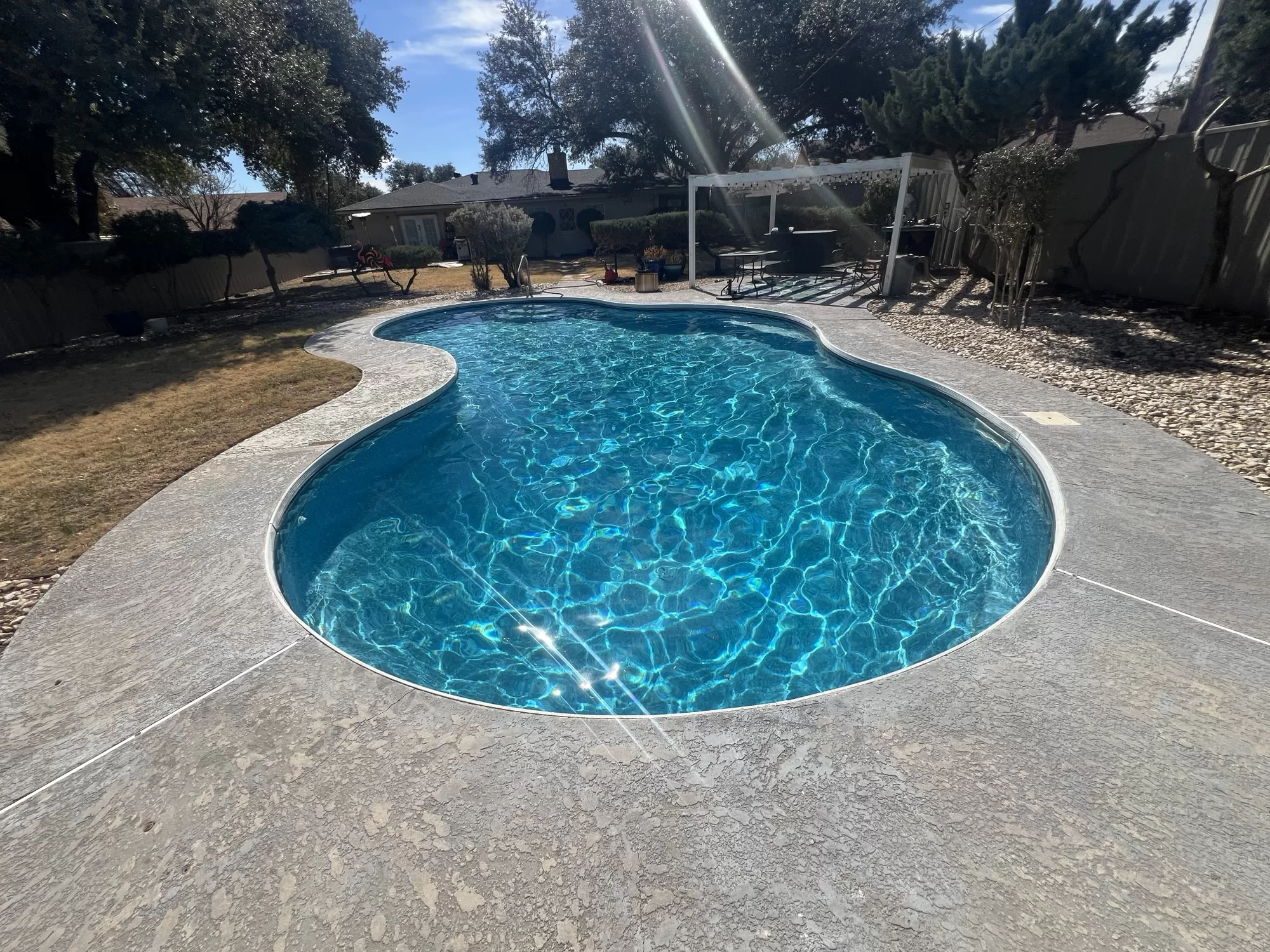
Keep track of chlorine, water balance, and the generator
A saltwater pool uses a generator to produce chlorine from dissolved salt. The equipment reduces routine manual chlorine dosing, but water testing, debris removal, and filter maintenance still matter. A normal-looking control panel does not tell you whether the water has enough free chlorine today.
For help reviewing the water and equipment together, see Concho Valley Pool’s San Angelo pool cleaning services. Start with the generator model, cell model, current test results, and any displayed warnings.
Use the salt target for your exact system
There is no universal salt concentration for every chlorine generator. For example, the Hayward AquaRite 900 manual gives a range of 2,700–3,400 ppm, with 3,200 ppm optimal. Pentair specifies an ideal of 3,600 ppm for its IntelliChlor Plus and LT generators. Use the manual for the unit installed at your pool.
Confirm an unexpected control-panel reading with an appropriate independent salt test before adding more salt. Check the correct pool volume and the manufacturer’s addition procedure. If the water test and display disagree, investigate the difference rather than repeatedly adding bags to make a warning disappear.
Salt generally needs replenishment when salt-containing water leaves the pool and is replaced with fresher water, such as after splash-out or backwashing. Evaporation by itself does not remove dissolved salt. Jandy’s AquaPure guidance emphasizes testing salinity before any addition. A falling water level alone is not an instruction to add salt.
Build a testing routine around actual pool use
Check free chlorine and pH rather than relying on smell, water appearance, or the percentage shown on the generator. The CDC’s home-pool testing guidance recommends testing disinfectant and pH at least twice daily, with more frequent checks during heavy use.
Use the equipment instructions and sanitizer-label requirements to set the appropriate operating targets. Also track total alkalinity, calcium hardness, and cyanuric acid on the schedule recommended for the system. Outdoor sunlight, swimmer load, and water temperature can change chlorine demand. A setting that worked earlier in the season may need adjustment.
A simple log should include:
- Date, free chlorine, pH, and periodic salt-test results
- Pump operating schedule and generator output setting
- Generator warning lights or error messages
- Recent heavy use, rainfall, water replacement, or chemical additions
- Filter cleaning and cell inspection dates
Record what changed before making another adjustment. That is more useful for diagnosis than a list of products added without corresponding test results.
If chlorine is low, check production and demand
First confirm the water test. Then check whether the generator is actually in its producing state, whether water flow is adequate, and whether the pump schedule allows sufficient production time. Output percentage controls generation; it does not directly measure the pool’s chlorine concentration.
Review alarms, salt concentration, recent water temperature, and the cell’s inspection history. Some generators reduce or stop production in cold water, and the threshold is model-specific. Low chlorine can also reflect increased demand rather than a failed cell. The IntelliChlor IC-series manual explains its operating indicators and troubleshooting sequence.
If circulation is poor, inspect the accessible water level and basket conditions safely before blaming the generator. Never bypass a flow switch, interlock, or other protective control to force chlorine production. Keep the pool closed to swimming when water quality or visibility is unsuitable, and get a treatment plan based on measured conditions.
Inspect the cell before deciding it needs cleaning
Follow the inspection interval for your generator. Hayward’s AquaRite 900 instructions call for inspection every three months or after filter cleaning. An inspection reminder does not automatically mean that acid cleaning is required.
Before removing a cell, shut down and isolate the generator and pump, prevent automatic restart, and follow the equipment instructions for releasing pressure and controlling water flow. Look for deposits without scraping or damaging the plates. Use only the cleaning method permitted for that cell, and avoid unnecessary chemical cleaning.
Persistent scale warrants a water-balance review. Have a qualified service provider handle acid treatment if you are not familiar with the cell’s exact instructions and chemical precautions. Do not use homemade cleaning recipes or mix cleaning products.
Know when the issue needs professional service
Repeated alarms despite verified water chemistry, damaged cell connections, leaks, and recurring low chlorine need further diagnosis. Leave controller wiring, power-center work, bonding, and electrical fault testing to qualified professionals. Repeated breaker or GFCI trips are a stop signal, not something to reset until the equipment runs.
For saltwater-pool maintenance in San Angelo, contact Concho Valley Pool or call or text 469-585-4093. Include photos of the controller and cell labels, the exact warning message, and recent water-test results so the next service step can be discussed.
Tags: chlorine generator service, pool cleaning service near me, pool salt cell maintenance, pool service san angelo tx, salt water pool care, san angelo pool cleaning